

What Is Diwali, and Why Do We Celebrate It?
Diwali, the Festival of Lights, is celebrated on the darkest night of autumn with rows of small clay lamps. Discover what it means, the story behind it, and seven ways this ancient festival brings real good to families, communities and villages, from India to Cambodia. If your site wants something shorter, here’s a one-line version: What is Diwali, and why do we celebrate it? The story, the meaning, and seven benefits of the Festival of Lights.
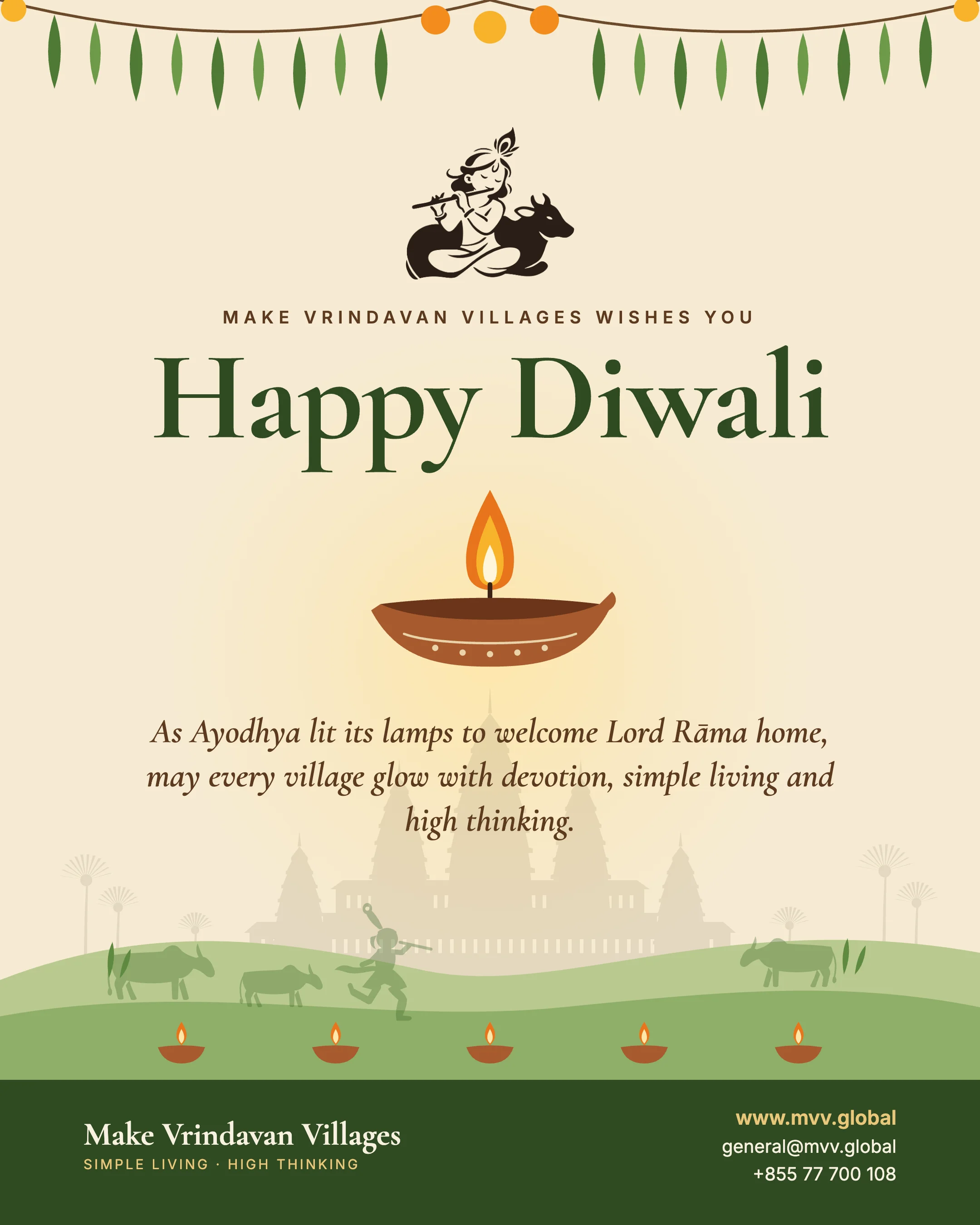
Happy Diwali from all of us at Make Vrindavan Villages! Diwali, the Festival of Lights, is one of the oldest and most widely celebrated festivals in the world. On the darkest night of the autumn moon, families in India, Cambodia and far beyond light rows of small clay lamps. The message is simple and universal: light is stronger than darkness, and there is always a way back home.
At Make Vrindavan Villages (MVV), we see Diwali as more than a celebration. It reminds us of a gentler way of living: close to the land, close to family and community, and close to God.
Diwali at a glance
Question | Answer |
|---|---|
What does the name mean? | Deepavali means "a row of lamps" in Sanskrit |
When is it? | The new-moon night of the autumn month of Kartika (October or November); in 2026 it falls on 8 November |
How long does it last? | Five days, with the main celebration on the third night |
What is the main symbol? | The diya, a small clay lamp filled with oil and a cotton wick |
Who celebrates it? | Hindus, Jains, Sikhs and many others in India, Southeast Asia and around the world |
Why celebrate Diwali? Seven benefits
Diwali is not only a holiday. For thousands of years it has done real good for people, families and villages. Here is how.
- It teaches that good wins over evil. Through the story of Rama, children learn that honesty, courage and loyalty win in the end, even after long hardship.
- It cleans and renews the home. Before Diwali, families clean, repair and decorate their houses. Coming after the long rainy season, this clears away dust, damp and pests and makes the home fresh for the cooler months.
- It brings families together. Relatives travel home, cook and eat together, and often settle old quarrels. Many people say Diwali feels like a new beginning.
- It builds community. Neighbours visit each other and exchange sweets and greetings, whatever their background. Lighting the whole street together turns individuals into a community.
- It supports village livelihoods. Potters make the lamps, farmers supply grain, milk and sugar for the sweets, and craftspeople make the decorations. When we buy local, the festival puts money directly into village hands.
- It teaches gratitude. Diwali comes at harvest time. It reminds us to thank the land, the animals and God for the food on our table.
- It gives hope. Diwali is held on the darkest night of the month. Lighting one small lamp shows that a single good act can push back the darkness, a lesson for every age and every difficulty.
The story behind the lamps
Diwali comes from the Ramayana, one of India's great ancient epics. It tells of Prince Rama, who was sent away from his kingdom for fourteen years. During that time he rescued his wife Sita from the demon king Ravana. When Rama finally returned to his city of Ayodhya, the people had no electricity and no fireworks. They had clay, oil and cotton wicks, and they lit every doorway, rooftop and riverbank to welcome him home.
That welcome came from the whole community. Farmers, potters, herders and craftspeople each brought what their own hands had made. A city lit up by its villages: this is the picture of Diwali we hold close.
A festival of harvest, cows and gratitude
Diwali falls at harvest time, when the rains are over and the grain is gathered in. For village families it has always been a time to give thanks for what the land has given.
In many places, the day after Diwali is Govardhan Puja. It recalls a story about Krishna, who grew up as a cowherd boy in the village of Vrindavan. Krishna told the villagers to give thanks to the hill and the cows that fed them, rather than to distant powers. When a great storm came, the story says, he lifted the hill and sheltered the whole village and all its animals beneath it.
The lesson speaks to anyone who has ever grown food or kept animals. The land and the cow are not just resources to use up. They are gifts that keep a community alive, and they deserve our care and gratitude.
Every village a lamp
MVV is built on a simple idea: simple living, high thinking. We help communities and farm projects create self-sufficient villages, where people grow their own food, care for the soil and the animals, and keep spiritual values at the centre of daily life.
Today many of us live surrounded by screens and city lights, yet feel more in the dark than ever. We believe every village built this way is like one small clay lamp. On its own it gives a little light. Placed side by side, such lamps can light the way home for a whole country, just as the people of Ayodhya once did.
Celebrating Diwali the village way
- Light real lamps. Use clay lamps with natural oil and cotton wicks instead of electric lights.
- Take a quiet moment. Before the celebrations, sit with your family, light a lamp and give thanks for the year.
- Care for the animals. Feed and decorate local cows, visit a farm, or support a shelter that protects them.
- Cook from the land. Make sweets and festive dishes from local, seasonal and natural ingredients.
- Share with others. Invite your neighbours, share food and sing together as one community.
- Skip the smoke. Choose lamps, music and flowers over firecrackers, for the animals, the air and the children.
A Diwali blessing
May the light of these lamps chase the darkness from our hearts and homes. May every home and every village become a place of kindness, gratitude and peace, ready to welcome what is good, just as Ayodhya welcomed Rama.
Happy Diwali from the Make Vrindavan Villages family.